
With highly inflated EV companies, this analysis has a few differences than the usual valuation analyses I do of other industries.
For example, I did not remove outliers. That would exclude companies like Tesla, and Tesla is at the forefront of the EV valuations, so they should be a part of the dataset. Companies with revenues below $100 million were removed.
What I was curious about was if companies that had 100% EV focus are given higher valuation premiums than companies with less EV focus.
With that in mind, the following are the subset of data that I analyzed:
- Car manufacturers that include all motor and EV.
- Companies that have ventured into EV – whether they have 100% EV sales or are in the development stage.
- Companies that have publicly committed to increasing EV sales going forward – so even if they only have 0% of EV sales out of total sales, they are actively developing and launching EV production and sales.
- Finally, companies that are 100% EV.
Revenue and EBITDA Multiple Automotive Industry
Out of 101 global auto manufacturers that include both gas-powered and electric vehicles or both.

- The median revenue multiple (P/S) is 0.8x. The range is wide from 0.1x to 11.2x. Again, I did not exclude outliers, because these are real inflated valuation multiples like Tesla, as absurdly high as it is.
- The median EBITDA multiple for 78 car manufacturers (EV/EBITDA) is ~10x.
- The median PE multiple for 76 car manufacturers is ~16x.
Electric Vehicle Manufacturer Valuation Multiples
Do we see higher valuation multiples for electric vehicle companies?
For “Any EV” companies, meaning they are car manufacturers that have ventured into electric vehicles whether by way of already producing and selling them or in the development phase.
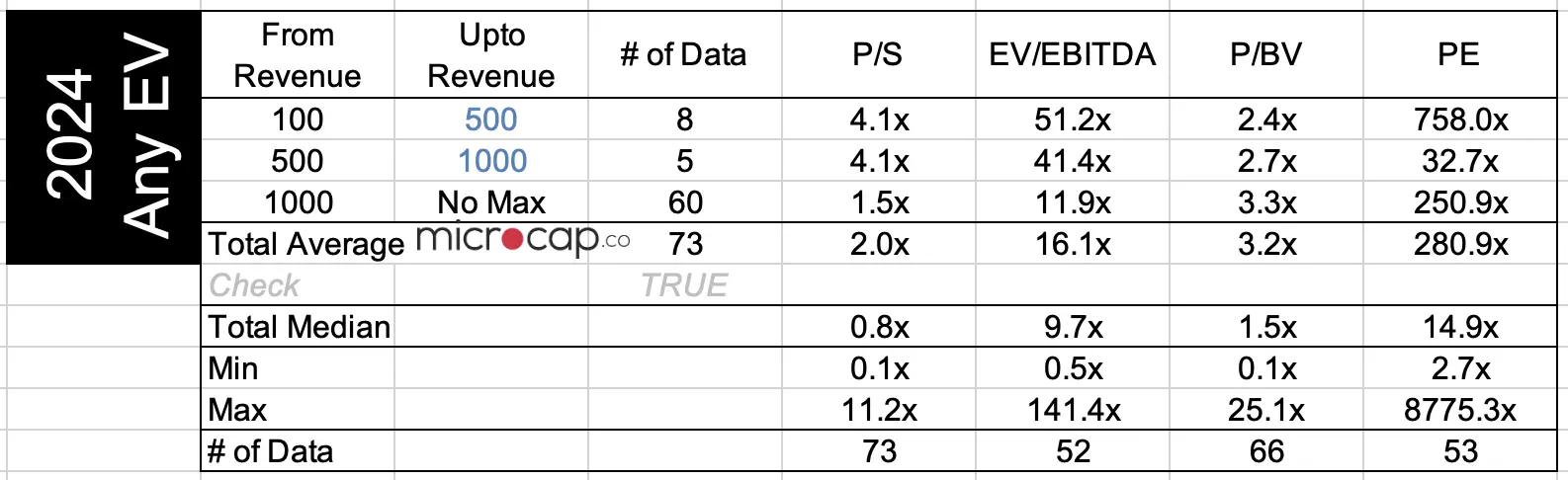
- For these 73 companies, there is hardly any change to their valuation.
- The median revenue multiple is 0.8x.
- The median EBITDA multiple is ~10x.
- The median PE multiple is ~15x. There is a slight decrease here compared to all car manufacturers.
For “>1% EV” companies, meaning these car manufacturers have begun producing and selling electric vehicles either solely or in addition to their internal combustion engine (ICE) cars, the valuation multiples are slightly lower.

- The median revenue multiple is the same at 0.8x.
- The median EBITDA multiple is 8.4x.
- The median PE multiple is 10.2x.
This category includes major car brands like Hyundai, Volkswagen, Toyota, GM. Their EV sales volume out of total sales volume ranges from 1% to 50%.
The reason for lower EBITDA and PE multiples may be attributed to the high upfront costs to develop and produce the electric vehicles.
These costs will be reduced with economies of scale. But at the onset, the market valuation may reflect the higher cost and lower profitability that is anticipated in the imminent years.
For car manufacturers that are solely 100% electric vehicle focused, such as Tesla, Rivian, Lucid, Nio, Polestar, the valuation multiples are priced at a premium.
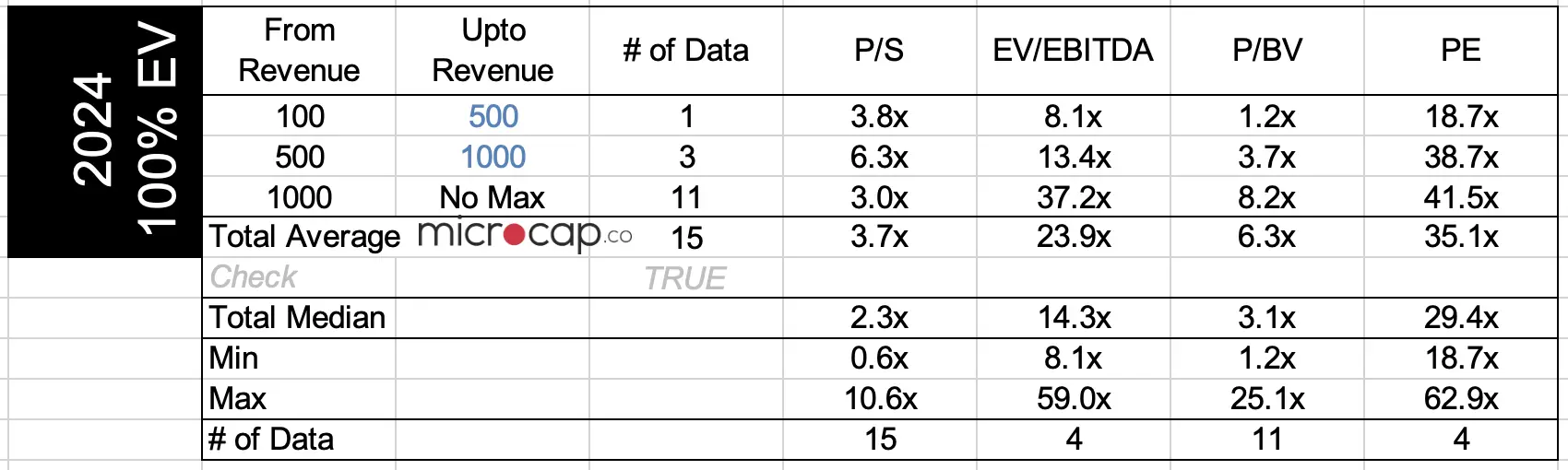
- The median revenue multiple is 2.3x compared to 0.8x for all car manufacturers.
- The median EBITDA multiple is 14.3x compared to ~10x for all car manufacturers.
- The median PE multiple is 29.4x compared to ~16x for all car manufacturers.
That is an interesting observation. The market does not reward car manufacturers for just having a commitment to switch the fleet to electric vehicles.
Rather, the valuation premium is given only to companies that are 100% electric vehicles focused.
Car Company Margins – Gas vs Electric Difference?
For all car manufacturers, including gas and electric vehicles:
- The median gross margin for 97 car manufacturers is 19%.
- The median EBITDA margin for 79 auto companies is 10%.
- The median net profit margin for 81 auto companies is 5%.

Comparatively, for 100% electric vehicle focused companies:
- The median gross margin for 10 data points is 19%.
- The median EBITDA margin for 4 data points is 10%.
- The median net profit margin for 4 data points is 5%.
 It’s not fairly reasonable to compare the profit margins when there are only 4 data points for the 100% EV companies’ EBITDA and net profit margins.
If the data set was robust, and the margins were still looking similar to what they are now, then it’s interesting to see that the EBITDA margin is higher for all car manufacturers compared to EV-only but net profit margin is higher for EV-only companies.
Perhaps the reason is that EV manufacturers are able to deduct tax incentives so their after-tax net profit margins are higher.
EV Companies that went Bankrupt
Electric vehicle companies currently command twice the valuation of all other car manufacturers, but this wasn’t the case until only a few years ago.
Electric vehicle companies that went bankrupt were ahead of their time before the infrastructure was widely available and naturally, they had to fail in order for the battery to improve in the market.
Below table are some of the EV companies that went bankrupt or were acquired, which includes Fisker.

Download 2024 Data
To download the dataset consisting of ~100 companies in this analysis, enter your email address below to sign-up for the mailing list and the data set will be sent to your email directly. In some cases, it takes a few hours or a day to receive the email with the data set.
