
Life science companies operate in diverse fields, from genomics and diagnostics to pharmaceuticals, agricultural biotechnology, and bioinformatics.
Life science companies often provide tools and solutions that underpin breakthroughs in healthcare and environmental science, making them a cornerstone of scientific advancement.
Over the past few years, the valuation of life science companies has fluctuated, driven by macroeconomic factors and sector-specific dynamics.
During the pandemic, the sector saw a surge in valuations as demand for diagnostic tools, vaccines, and research technologies skyrocketed. Valuations normalized in 2023.
In 2024, as with many other industries, life science companies experienced a renewed focus on profitability and operational efficiency, with investors emphasizing recurring revenue models, such as licensing agreements for research tools and diagnostic platforms.
Companies involved in advanced technologies like CRISPR-based gene editing and single-cell sequencing maintained higher revenue multiples due to their disruptive potential.
Life Science Company Valuations
The median revenue multiple for 120 life science companies is 3.4x. The median EBITDA multiples for 59 life science companies is 20.3x. The median PE ratio for 42 life science companies is 32.1x.
The dataset includes companies in US, Canada, UK, France, Germany, South Korea, and Japan, the companies at the forefront of life sciences R&D.
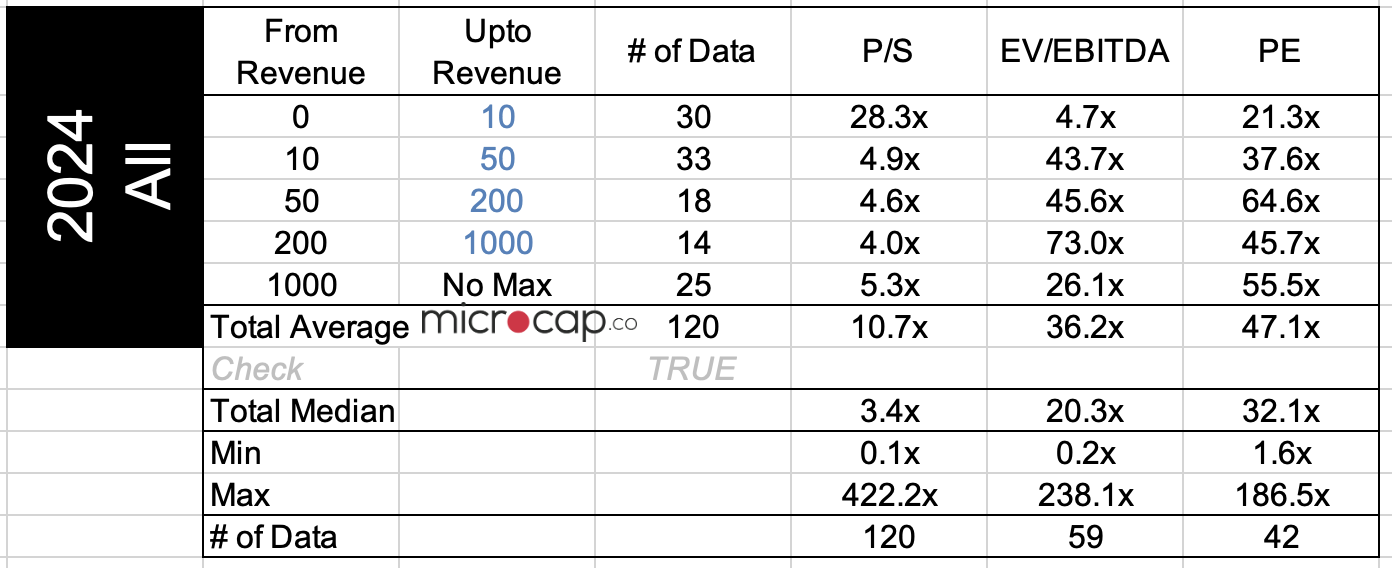
The range of multiples varies widely. I didn’t remove outliers, because the high valuation multiples for life science companies is valuable information as they are indicative of investor sentiment.
Life science companies are not profitable when they start and due to the nature of high R&D activity at the inception of the company, revenue may be 0 for years as long as they have funding before they commercialize.
For the companies in the dataset that have revenue less than $10 million, the average revenue multiple is 28.3x compared to the median of 3.4x. Meanwhile, the average EBITDA multiple for these companies is 4.7x.
This opposite effect of valuation multiples compared to all life science company size range demonstrates that investors value startup life science companies during their research & development phase. Investors are buying into the promise of what can be achieved from the R&D.
Life Science Company Margins
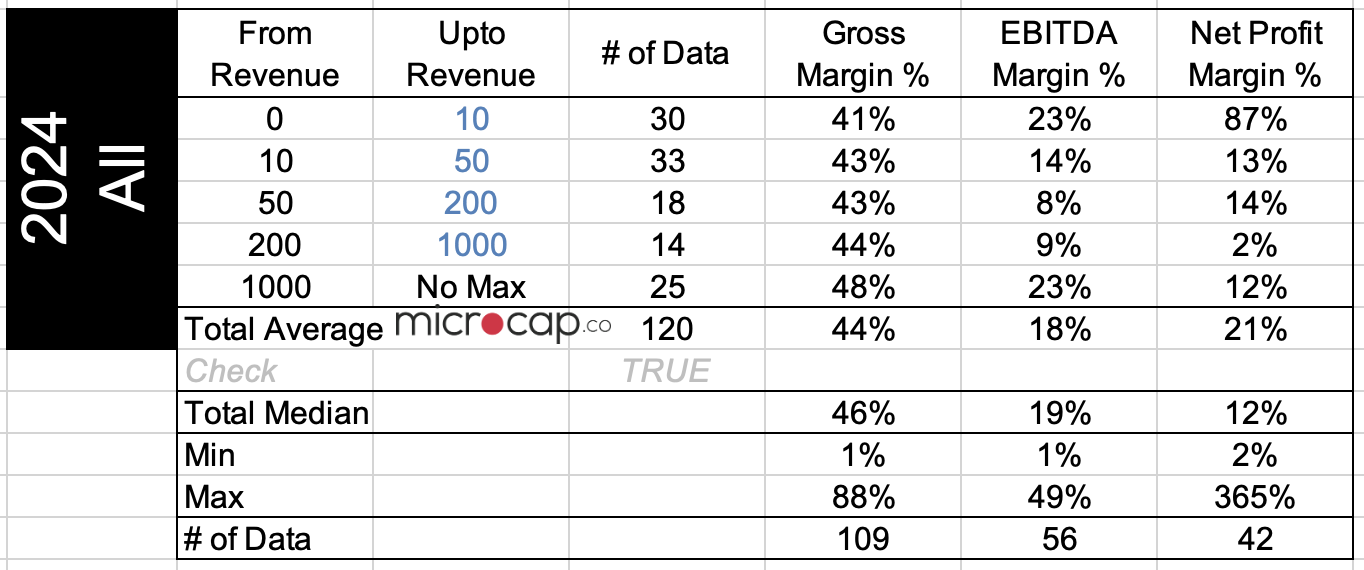
The median gross margin for 109 life science companies is 46%. The median EBITDA margin for 56 life science companies is 19%. The median profit margin for 42 life science companies is 12%.
Life Sciences Industry Trends 2025
Looking ahead to 2025, the integration of artificial intelligence (AI) in research and drug discovery is expected to enhance the efficiency of R&D pipelines.
Increased regulatory scrutiny, particularly for genomic and personalized medicine, may affect companies operating in these high-growth areas, emphasizing the importance of compliance and robust clinical validation.
And the expansion of precision agriculture and environmental biotechnology is likely to drive growth in life science firms that address sustainability challenges.
Investors in 2025 will likely favor companies with scalable technologies, recurring revenue streams, and strong intellectual property portfolios.
Life science companies that can navigate regulatory landscapes, demonstrate clear paths to market for innovative technologies, and align with global priorities like sustainability and health equity will remain attractive investment opportunities.
Download 2024 Data
To download the dataset consisting of 120 companies in this analysis, enter your email address below to sign-up for the mailing list and the data set will be sent to your email directly. In some cases, it takes a few hours or a day to receive the email with the data set.
