
The valuation landscape in the healthcare industry has seen significant shifts in recent years, particularly in 2024, similar to biotech and life sciences.
I grouped healthcare companies into 3 subsets for the purposes of valuation multiple analyses:
- Healthcare technology companies
- Healthcare equipment and supplies manufacturers
- Healthcare service providers
As expected, healthcare tech companies had the highest valuation multiple with a median revenue multiple of 2.3x, then healthcare equipment supplies companies with a median revenue multiple of 2.2x, and healthcare service providers had the lowest with a median revenue multiple of 0.9x.
Let’s dive into the analysis of each subset.
Healthcare Tech Valuation Multiples
Healthcare technology companies, including those specializing in telemedicine, data analytics, and artificial intelligence (AI), experienced elevated valuations during the pandemic as investors flocked to digital health solutions.
However, by 2024, valuations normalized as growth rates slowed, and profitability became a focal point.
Price-to-sales (P/S) revenue multiples for healthcare tech companies decreased compared to their pandemic-era highs, with investors scrutinizing operational efficiency and the scalability of platforms.
Companies demonstrating consistent revenue streams from subscription-based models or partnerships with healthcare providers managed to maintain relatively high multiples.
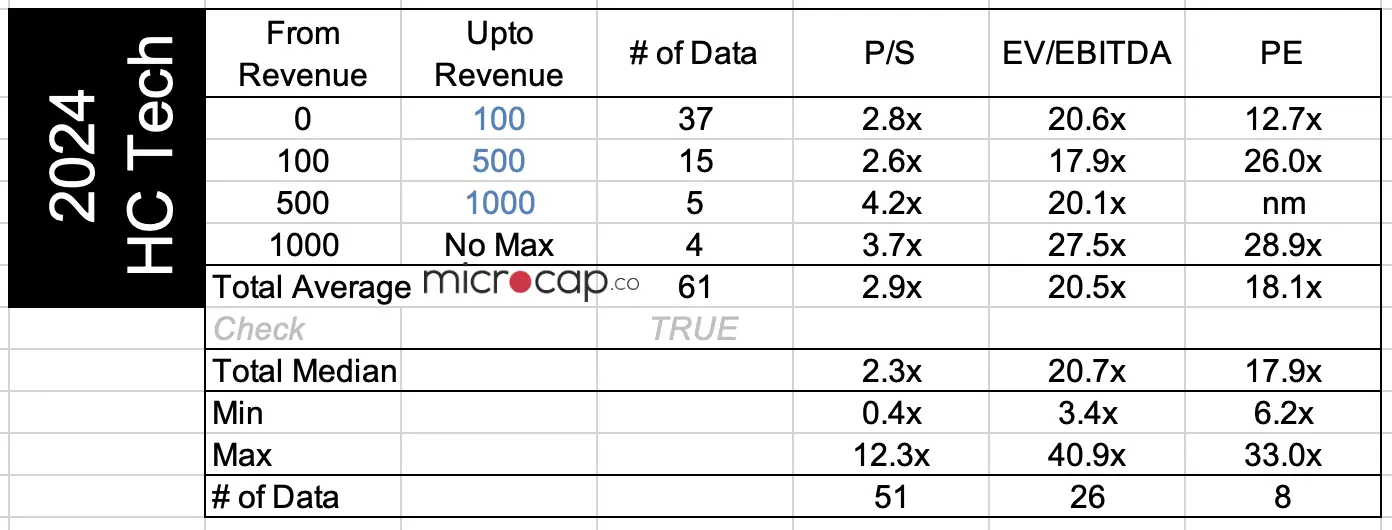
After removing for outliers and not available data, the median P/S revenue multiple for 51 health tech companies is 2.3x. The median EV/EBITDA multiple for 26 companies is 20.7x. The median PE ratio for 8 companies is 17.9x.
The PE ratio dataset only had 8 companies as most of the healthcare tech companies were not profitable.
Healthcare Equipment Supplies Valuation
For healthcare equipment and supplies companies, 2024 saw a resurgence in demand for diagnostic equipment and surgical tools, as elective procedures returned to pre-pandemic levels.
EV/EBITDA stabilized, reflecting the sector’s strong revenue recovery and improved supply chain efficiencies.
Companies with diversified product portfolios or innovative solutions, such as robotics-assisted surgery tools or advanced imaging devices, attracted premium valuations.
However, rising raw material costs and geopolitical uncertainties created headwinds for some firms.
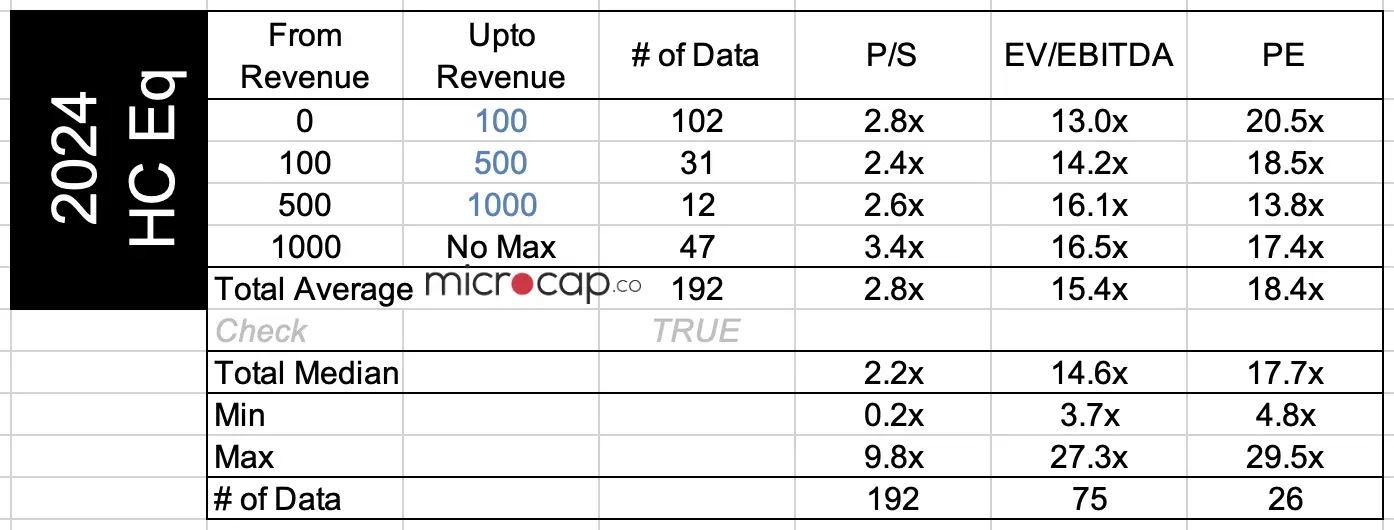
The median revenue multiple for 192 healthcare equipment companies is 2.2x. The median EBITDA multiple for 75 healthcare equipment companies is 14.6x. The median PE ratio for 26 companies is 17.7x.
Notice that the revenue multiples are similar between healthcare tech companies and healthcare equipment supplies companies, but EBITDA multiple is higher for healthcare tech companies.
EBITDA multiples reflect profitability, and healthcare tech companies typically have higher multiples despite similar revenue multiples, because healthcare tech companies tend to have higher margins due to less capital intense maintenance costs once the product scales and because investors tend to place higher valuations on healthcare tech that is more innovative and scalable.
For medical device research and development companies’ valuation multiples, go to the post here.
Healthcare Services Valuation Multiples
Healthcare service providers, including hospitals, clinics, and long-term care facilities, faced a different valuation environment.
Labor shortages and increased wage pressures weighed on profit margins, pushing EV/EBITDA multiples lower than historical averages.
Despite these challenges, providers offering specialized care or operating in regions with favorable payor mixes saw better valuation outcomes.
The industry’s consolidation trend continued in 2024, with larger players acquiring smaller, struggling facilities to expand market share and geographic reach. This dynamic contributed to differences in valuations across different service providers.

The median revenue multiple for healthcare service providers is 0.9x for 143 companies. The median EBITDA multiple is 11.5x for 91 companies. The median PE ratio for 58 companies is 17.6x.
Healthcare Company Margins
Healthcare tech companies had the highest median gross margin compared to the other subsets of healthcare companies.
The higher gross margin is explained by the nature of the business for healthcare tech companies as they have recurring revenue in the form of subscription-as-a-service (SaaS).
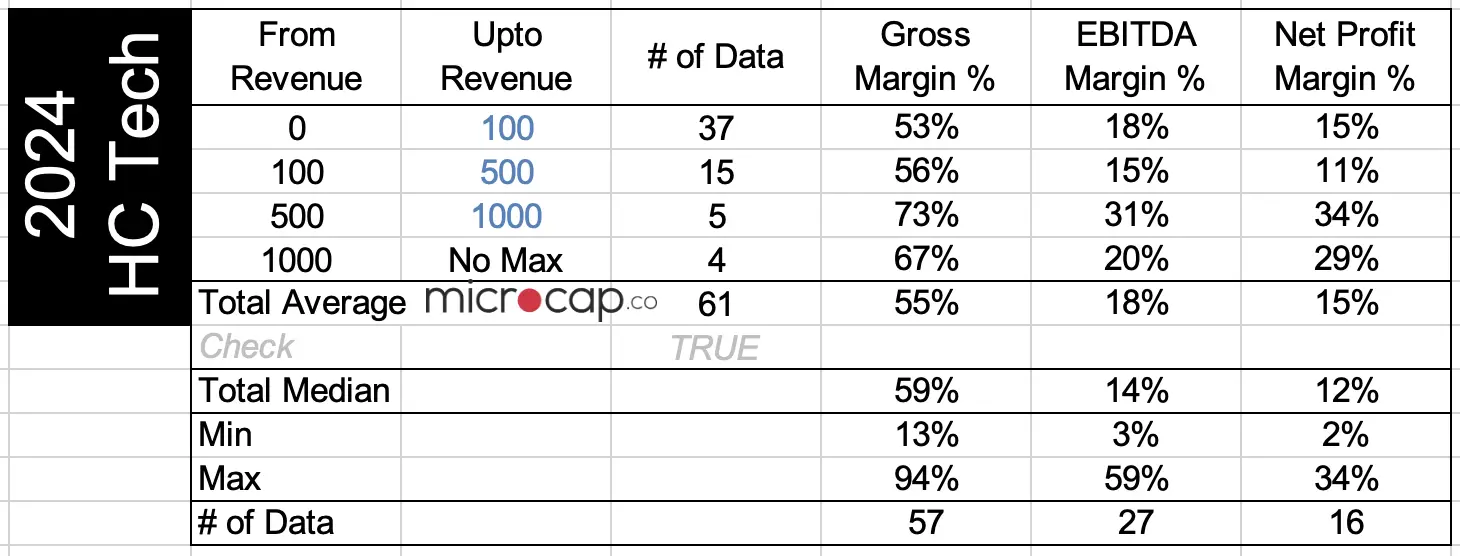
As the healthcare tech companies scale, they would have higher margins, and this is what we see in the dataset analysis as well.
Companies with revenue less than $500M had gross margin in the ~54% range whereas companies with revenue over $500M has average gross margin of ~70%.
Healthcare equipment and supplies companies also had higher gross margin with a median of 58%. For equipment companies, due to higher maintenance of operating expenses compared to healthcare tech companies, the gross margin does not increase with higher scale of companies.
Healthcare equipment and supplies companies also had lower median net profit margin compared to healthcare tech companies.

As expected, healthcare service providers had the lowest margins compared to other healthcare sub-industry companies. Service based companies tend to have lower margins because competition is fierce.

Healthcare Company Trends in 2025
The healthcare industry is poised for dynamic shifts in 2025, with healthcare technology companies, healthcare equipment and supplies manufacturers, and healthcare service providers all navigating unique trends.
Healthcare tech
Healthcare tech companies will continue to focus on integrating artificial intelligence (AI) and machine learning (ML) into digital health platforms. This includes predictive analytics, patient engagement, and personalized care. In addition, the adoption of blockchain for secure data management may finally take off.
During the pandemic, all healthcare tech companies saw a surge in valuation because of the necessity of digitized products.
Now that the industry is stabilizing, there is a focus on value-based care models, meaning the tech companies need to show measurable outcomes. This may encourage more partnerships between tech companies and traditional providers.
Healthcare equipment and supplies
Healthcare equipment and supplies companies are expected to capitalize on advancements in robotics, 3D printing, and wearable medical devices.
Robotics-assisted surgery tools and precision imaging devices are likely to see increased adoption as healthcare providers invest in cutting-edge technologies to enhance care quality.
The trend toward miniaturization of devices, coupled with rising consumer interest in at-home monitoring, will boost demand for portable and wearable healthcare equipment.
However, companies in this sector will face challenges from rising material costs and ongoing supply chain disruptions, necessitating strategic sourcing and cost management innovations.
Healthcare service providers
For healthcare service providers, the focus will shift toward addressing labor shortages and improving operational efficiency.
The rise of hybrid care models, blending telemedicine with in-person visits, will reshape how services are delivered, particularly in rural and underserved areas.
Providers will also seek to expand specialized care offerings, such as oncology and geriatric services, to meet growing demand from aging populations.
Consolidation within the industry is expected to continue, as larger organizations acquire smaller facilities to diversify offerings and strengthen regional presence.
These trends underscore the importance of innovation, adaptability, and strategic partnerships across the healthcare ecosystem.
Companies that leverage technology to address evolving patient needs, streamline operations, and improve care outcomes will be well-positioned for success in 2025.
Download 2024 Data
To download the dataset consisting of ~400 companies in this analysis, enter your email address below to sign-up for the mailing list and the data set will be sent to your email directly. In some cases, it takes a few hours or a day to receive the email with the data set.
